

Axiom.trade Review
Introduction to Axiom.trade
In the rapidly evolving world of cryptocurrency trading, platforms that combine speed, intelligence, and integrated tools are becoming increasingly popular. One such platform gaining attention among active traders is Axiom.trade. Designed primarily for on-chain trading, Axiom.trade positions itself as an advanced trading terminal that integrates analytics, wallet monitoring, social signals, and trading execution into a single environment.
Unlike traditional centralized exchanges that mainly focus on simple buying and selling of cryptocurrencies, Axiom.trade aims to provide a comprehensive trading ecosystem. It targets experienced traders who require real-time insights, fast execution, and advanced tools to navigate volatile markets—particularly within the decentralized finance (DeFi) and Solana ecosystems.
The platform combines several core functionalities including spot trading, perpetual futures trading, staking, wallet tracking, and social sentiment monitoring. Its vision is to reduce the need for multiple tools by consolidating the entire trading workflow into a single interface. This approach appeals to traders who rely heavily on speed and information to gain an edge in highly competitive markets.
However, while Axiom.trade offers a sophisticated feature set, it is also associated with the inherent risks of high-frequency and speculative crypto trading. Therefore, understanding its capabilities, security measures, fees, and reputation is crucial for anyone considering using the platform.
This comprehensive review examines Axiom.trade in depth, analyzing its features, user experience, security practices, pricing structure, customer support quality, and overall reliability to help traders make an informed decision.

Key Features and Trading Capabilities
On-Chain Spot Trading
At its core, Axiom.trade provides on-chain spot trading capabilities, primarily focused on tokens within the Solana ecosystem. Rather than functioning as a traditional custodial exchange, the platform connects directly to blockchain networks, allowing users to trade assets while maintaining control over their wallets.
This decentralized approach offers several advantages. First, users retain ownership of their funds instead of depositing them into an exchange-controlled wallet. Second, trades are executed directly on-chain, increasing transparency and reducing counterparty risk.
The platform allows traders to quickly discover new tokens, monitor liquidity pools, and execute trades with minimal delay. Fast execution is particularly important in volatile markets where prices can change rapidly within seconds.
Perpetual Futures Trading
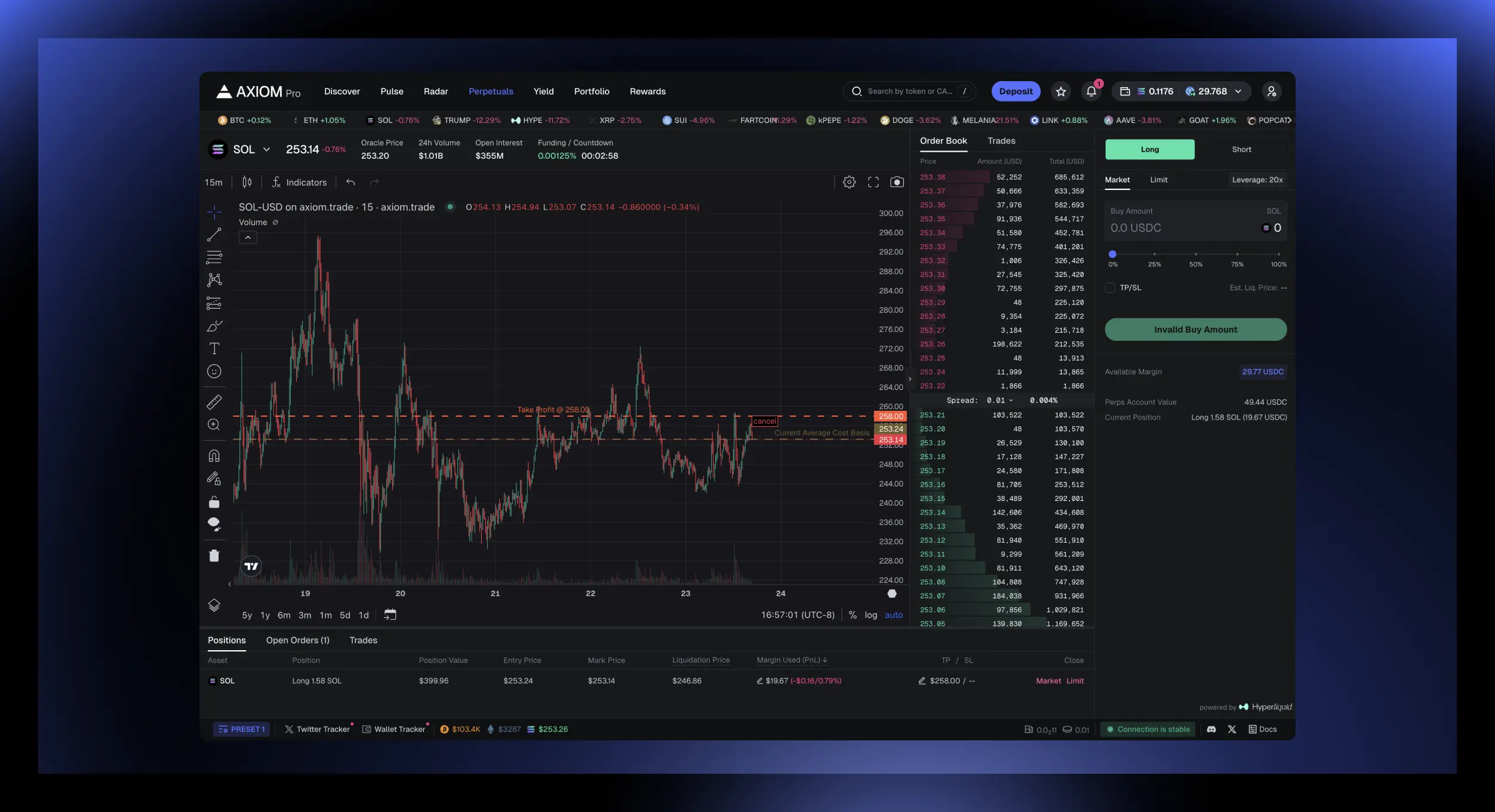
Another major component of Axiom.trade is its support for perpetual futures trading. Through integration with decentralized derivatives protocols, traders can open long or short positions using leverage.
Leverage can reach high levels—sometimes up to 50x—allowing traders to amplify their exposure to price movements. While this can significantly increase potential profits, it also increases the risk of rapid liquidation if the market moves against the position.
The perpetual trading interface typically includes:
- Real-time position monitoring
- Open order tracking
- Margin management
- Liquidation thresholds
- Trade history analytics
These features make it possible for advanced traders to implement complex strategies without leaving the platform.
Wallet Tracking and Smart Money Monitoring
One of the most distinctive tools offered by Axiom.trade is its wallet tracking system. This feature allows traders to monitor the activity of specific blockchain wallets in real time.
Many crypto traders follow so-called “smart money” wallets—addresses known for consistently identifying profitable trades early. By observing the buying and selling behavior of these wallets, users may identify emerging trends before they become widely known.
The wallet tracker provides insights such as:
- Token purchase history
- Realized and unrealized profit and loss
- Holding duration
- Portfolio composition
For traders who rely heavily on behavioral analytics rather than purely technical analysis, this feature can be extremely valuable.
Social Sentiment Monitoring
Cryptocurrency markets are heavily influenced by social media sentiment. Tweets, announcements, and influencer commentary can trigger significant price movements.
To address this dynamic, Axiom.trade includes a tweet monitoring system that tracks posts from influential crypto accounts. When a monitored account publishes a tweet related to a specific token or narrative, traders can view the content directly within the platform.
This allows users to react quickly to breaking news or emerging trends without needing to constantly monitor external platforms.
Charting and Technical Analysis
Technical analysis remains a fundamental component of trading strategies. Axiom.trade integrates professional charting tools that allow traders to analyze price movements using indicators, trendlines, and historical data.
Key capabilities include:
- Candlestick chart visualization
- Technical indicators such as RSI and MACD
- Volume analysis
- Multi-timeframe charting
- Drawing tools for support and resistance levels
These tools help traders identify potential entry and exit points while evaluating broader market trends.
Token Risk Analysis
Another feature designed to assist traders is the platform’s token risk detection tools. In decentralized markets, newly launched tokens can sometimes be associated with scams, manipulation, or coordinated trading activity.
Axiom.trade attempts to address this by analyzing transaction patterns and wallet activity to detect unusual trading clusters or bundled transactions. By highlighting these patterns, the platform aims to help traders avoid risky tokens or potential market manipulation scenarios.

User Interface and Ease of Use
Axiom.trade places strong emphasis on speed and efficiency in its interface design. The platform is structured as a trading terminal where charts, order panels, wallet activity, and analytics are accessible within a single dashboard.
For experienced traders, this layout can significantly improve workflow efficiency. Instead of switching between multiple tools—such as charting platforms, social media feeds, and blockchain explorers—everything is available in one place.
Key interface advantages include:
- Clean and data-rich dashboard layout
- Fast order execution controls
- Integrated analytics panels
- Real-time market updates
- Customizable settings for slippage and priority fees
However, the platform’s feature-rich design can also create a learning curve for beginners. New users unfamiliar with decentralized trading may initially find the interface overwhelming due to the number of available tools and metrics.
Additionally, managing parameters such as slippage tolerance, transaction priority fees, and leverage settings requires a certain level of experience with blockchain trading mechanics.
Overall, the interface is clearly designed with active traders rather than casual investors in mind.
Security Measures and Trustworthiness
Security is one of the most important considerations when evaluating any cryptocurrency platform. Axiom.trade adopts a non-custodial model, meaning users maintain control over their private keys and funds.
Instead of holding assets on behalf of users, the platform interacts directly with blockchain networks and decentralized protocols. This reduces the risk associated with centralized exchanges, where funds are stored in large custodial wallets that may become targets for hackers.
Key security elements include:
- Non-custodial wallet integration
- On-chain transaction transparency
- Encryption and secure infrastructure
- Integration with external wallet services
Despite these strengths, it is important to recognize that the broader environment of DeFi trading still carries risks. Smart contract vulnerabilities, market manipulation, and extreme volatility can all affect users regardless of platform security.
Another factor influencing trust is public reputation. While Axiom.trade has gained traction among active traders and developers, some users have reported mixed experiences regarding platform reliability and customer support. As with many emerging crypto platforms, reputation can evolve over time as the platform matures.
Therefore, users should approach the platform with the same caution they would apply to any high-risk trading environment.
Fees, Commissions, and Trading Costs
Axiom.trade charges several types of fees associated with trading and blockchain activity.
Trading Fees
The platform uses a tiered fee system based on trading volume. Fees generally range around 0.75% to 0.95%, with higher-volume traders receiving partial cashback rewards in cryptocurrency.
This structure incentivizes frequent trading while maintaining a standard commission for smaller traders.
Blockchain Transaction Costs
Because trades occur on-chain, users must also pay network transaction fees. On the Solana blockchain, these costs are typically small but can increase during periods of network congestion.
To speed up transaction confirmation, users can choose to pay priority fees, which increase the likelihood that their transaction will be processed quickly.
Perpetual Trading Fees
Perpetual futures trading involves additional costs, including:
- Transaction fees for opening or closing positions
- Funding rate adjustments depending on market conditions
- Liquidation penalties if margin requirements are not maintained
These costs are common across most derivatives platforms but should still be considered when calculating overall trading profitability.
Staking and Yield Fees
For users participating in staking or yield programs, additional fees may apply. Some staking services charge a percentage of rewards as a commission for validator operations.
While these fees are relatively standard in DeFi ecosystems, traders should carefully review them before committing funds.
Customer Support and Service Quality
Customer support on Axiom.trade primarily operates through community channels, particularly Discord-based ticket systems. This approach is common among crypto-native platforms, where communities play an active role in assisting users.
Support channels generally allow users to:
- Submit technical support requests
- Report platform issues
- Ask questions about features or transactions
- Receive guidance from moderators or support staff
However, compared with traditional financial platforms that offer dedicated phone or live chat support, the reliance on community channels may feel limited for some users.
User feedback about support responsiveness has been mixed. While some traders report helpful interactions with the support team, others mention delays in receiving assistance during busy periods.
For traders managing large positions or operating in highly volatile markets, timely support can be critical. Therefore, this area remains one where the platform could potentially improve.
Comparison with Industry Standards
When compared with broader industry standards, Axiom.trade performs strongly in several areas but shows weaknesses in others.
Strengths Compared to Typical Platforms
Axiom.trade stands out due to its integrated trading intelligence tools. Features like wallet tracking, social sentiment monitoring, and token analytics are not always available on traditional exchanges.
Additionally, the platform’s focus on speed and real-time information makes it attractive to traders who rely on rapid decision-making.
Areas Where It Falls Behind
In contrast, many established platforms place greater emphasis on regulatory transparency, customer protection, and structured support systems.
Axiom.trade, like many newer DeFi-focused platforms, prioritizes innovation and trading flexibility over regulatory integration. While this can accelerate product development, it may also reduce perceived trust among more conservative investors.
Pros and Cons
Advantages
Axiom.trade offers several significant benefits:
- Comprehensive trading tools integrated into one platform
- Non-custodial architecture allowing users to retain control of funds
- Real-time wallet tracking and market intelligence
- Integrated charting and technical analysis tools
- Support for both spot and leveraged trading
- Advanced analytics for token discovery and market sentiment
Disadvantages
Despite its strengths, the platform also has notable limitations:
- High trading risk due to leveraged and speculative markets
- Fees that may feel expensive for small trades
- Learning curve for beginners unfamiliar with DeFi trading
- Customer support primarily limited to community channels
- Mixed reputation among users in online reviews
Final Verdict
Axiom.trade represents a new generation of on-chain trading terminals designed for highly active crypto traders. By combining advanced analytics, social sentiment monitoring, wallet intelligence, and trading execution within a single interface, the platform delivers an impressive toolkit for navigating fast-moving decentralized markets.
For experienced traders who thrive in high-volatility environments, Axiom.trade offers powerful capabilities that can streamline trading workflows and provide valuable market insights.
However, the platform is not without drawbacks. Its complex feature set, speculative trading environment, and mixed user feedback mean it may not be the best choice for beginners or risk-averse investors.
Ultimately, Axiom.trade is best suited for traders who understand the risks of decentralized finance and are comfortable operating in an environment where speed, strategy, and market awareness are essential.
For anyone considering using the platform, the most prudent approach is to start cautiously, test its features with smaller amounts of capital, and gradually increase exposure as confidence in the platform grows.
In summary, Axiom.trade is a powerful but specialized trading platform—one that offers impressive tools and innovation but requires knowledge, discipline, and careful risk management from its users.